Spring 2026 Update
The New Nursery
August 2024 – the irises arrive in Cumbria from Norfolk. Temporary housing is provided at Bob Bennett’s Nursery at Distington near Whitehaven. And, work on the new walled garden begins in December 2024, with the new Polytunnel complete by May 2025.
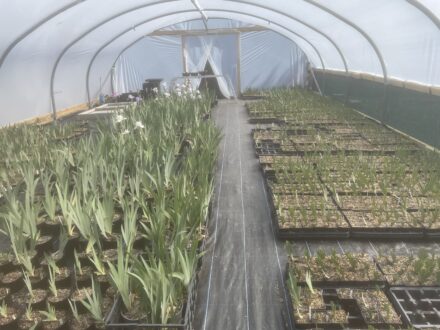
Polytunnel Complete and Filled June 2025
Raised Beds
We decide to create raised beds to house plants moved from Norfolk and some from the Lincolnshire site at Greetham. Work begins in July 2025, four on a bare site, and one against a west facing wall. We source the larch sleepers locally from a sustainably managed woodland near Penrith, and use a local saw-mill to cut the timber.
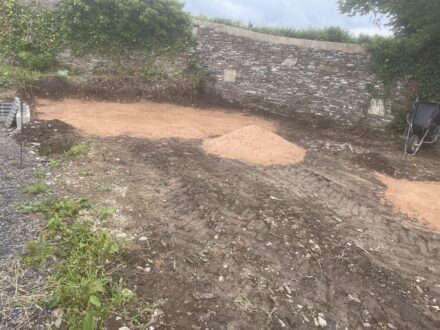
Levelled Bare Site
This continues over the next two/three weeks.
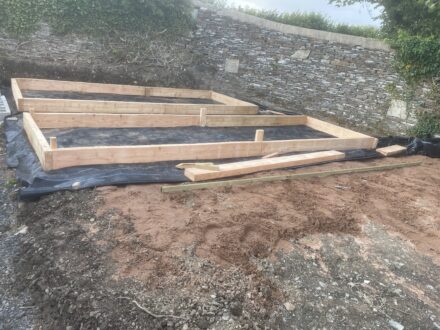
Work Under Way. Raised Bed framework in place.
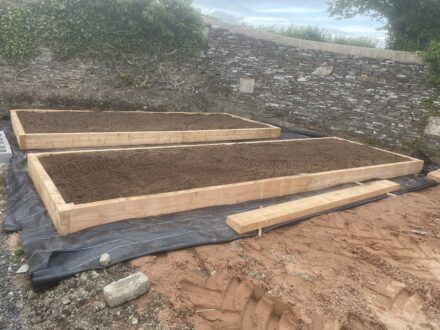
Getting the drainage right with more than twice the Norfolk rainfall is the priority. Drawing on our experience in Lincolnshire, we choose a sandy free-draining topsoil brought in from a local quarry. Again to help the drainage, we use a large quantity of pea shingle mixed with some peat-free compost in the planting mix. Rhizomes are placed on a mound of pea shingle, before being bedded in, and planting starts in August 2025 and is complete by October.
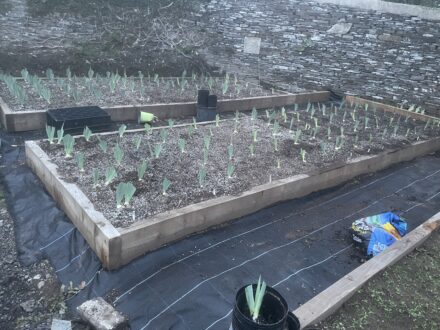
2026 to Date
The plants survive the winter well with few losses. Interestingly, we find that one of the biggest problems is keeping the plants in the ground. No, not rabbits this time! However, the site is exposed to the south/south-westerly winds that blow strongly up the valley from the fells ten miles away. When the winds blow hard, the iris ‘fans’ act like sales, and the plants blow over exposing the roots. This is more serious in the recent dry weather, and the roots of some of the more recent plantings are most affected. Recent rain helps. My plan is to anchor them with a small cane at the back of the fan with a split ring attached to both the plant and support. Over the next couple of months, with warmer weather, I expect the root systems to become much firmer and more established.
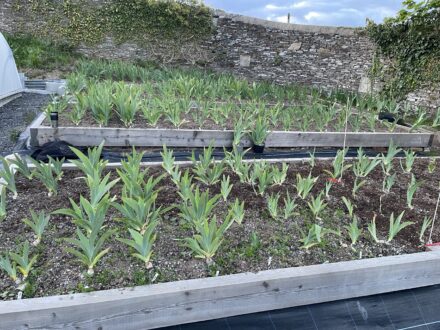
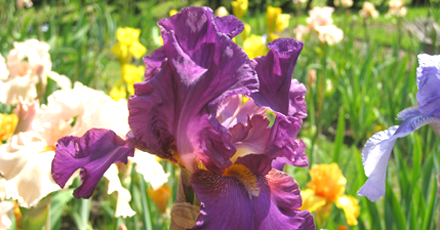
On a positive note, we are expecting a good number of the irises to flower this year. Quite surprising too as they have only been in the ground since September/October). Nonetheless, very encouraging. It shows clearly that Tall Bearded Irises will thrive in the North-West given the right conditions. This was always one of my stated objectives when we started the project.
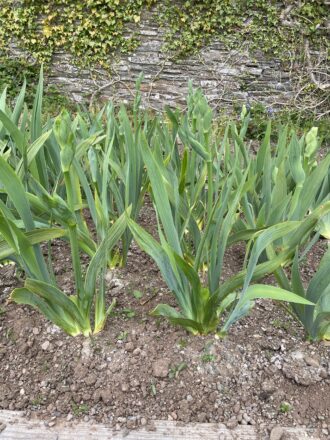
Flowers in Two/three weeks!
Next Stages
Our recent successes have encouraged me get on and build a new raised bed along a sixty foot (18.3m) section of a south facing wall. With an average depth of 4.5′ (1.4m), this will increase the capacity by over 40%. The new bed will be in full sun, sheltered by the Polytunnels and benefit hugely from the refracted heat of an 8′ (2.5m) stone wall that surrounds the site.
To support the bed, we need to construct a breeze block retaining wall, before removing a large quantity of soil saved previously when the site was levelled. The surplus soil will be used along the currently sloping western boundary to created an area for vegetables and a few fruit trees.
Finally, we plan to erect a second re-purposed polytunnel, slightly smaller than the first; this will be used to grow more Mature Plants.
Water
There is no water on site, and connection to the mains is expensive. To date we are managing to harvest water from the large Polytunnel, connected to a series of water buts that feed three 1000L plastic containers. The system is gravity fed. Fortunately, we have a backup plan in the event of as prolonged drought and have access to a remote water supply that could be used to top up the containers. So far, so good.
Lessons Learned
Drainage, Drainage,Drainage
This is essential. Use light free-draining soil, with plenty of pea shingle. It is vital to get the ground conditions right to avoid rhizome rot.
Good Plant Hygiene
Keep the plants clean at all times. Remove all dying leaves from the base of the rhizomes regularly. We find this is necessary to prevent the dead leaves acting like sponges at the base of rhizome, and absorbing the heavy rain. Sodden mushy leaves provided ideal conditions for rhizome rot and leaf spot, the scourge of all iris growers.
Strulch – Yes or No
Strulch is used extensively at Doddington, primarily a weed suppressant, but also as means to control slugs/snails. Moreover, it has the added benefit of raising the temperature around the rhizomes and encourages earlier growth. I plan to trial this in one of the raised beds this year. The main risks is that it too may turn to mush, and create a wholesale rot problem. There is no substitute for careful monitoring. I will. keep you posted.
Staking Irises
My site in the walled garden is relatively sheltered, but exposed to strong south/south-westerly winds. Staking irises under these circumstances is a small price to prevent iris stems with flowers being snapped or blown over.
Slug Control
Given increased rainfall, and generally damp conditions, regular treatment is required with a ferric phosphate ingredient, Sluxx works well.
The project continues.